Eighty million. That is how many Nigerian youth are currently unemployed or underemployed, according to the State of the Nigerian Youth Report 2025. Vocational training in Nigeria has been proposed, funded, announced, and relaunched under nearly every administration in living memory, yet the number keeps climbing. This post will not give you another hollow prescription. It will give you the data, the structural truth behind why the crisis persists, who is being left completely out of the conversation, and what a genuinely effective vocational intervention looks like when it is built with fidelity to the people it is supposed to serve.
Table of Contents
- Nigeria’s Youth Unemployment Crisis: What the Numbers Actually Say
- The Japa Conversation and Who It Leaves Out
- Why Vocational Training Programmes in Nigeria Keep Falling Short
- The Three-Part Formula That Actually Works
- What Happens When One Intervention Gets It Right
- How LiftOne’s Skill Lift Programme Is Closing the Gap
Nigeria’s Youth Unemployment Crisis: What the Numbers Actually Say
The statistics on youth unemployment in Nigeria exist in an uncomfortable tension with each other, and it is worth understanding why before trusting any single figure.
The National Bureau of Statistics recorded a headline unemployment rate of 4.3 percent in the second quarter of 2024, a figure that prompted cautious government optimism. The International Labour Organisation, speaking at a national dialogue on technical and vocational education and training in October 2025, placed youth unemployment at 6.5 percent by its own methodology, with women sitting significantly higher at 7.8 percent.
Both figures are technically accurate. Both figures are also profoundly misleading.
They are misleading because they measure people who are actively searching for work and not finding it. They do not measure the 93 percent of Nigeria’s workforce operating in the informal economy, often without stable income, without security, and without any genuine upward mobility. They do not measure the young people who have stopped searching entirely, and the World Economic Forum, in its November 2025 analysis of Nigeria’s labour market, estimated that 32 percent of young Nigerians have done exactly that. They are not counted as unemployed. They have simply vanished from the calculation.
The Afrobarometer Dispatch of June 2025, drawing on surveys conducted across Nigeria in 2024, contextualised the NBS methodology shift with uncomfortable directness: in 2020, before the revision, the official unemployment rate for Nigerians aged fifteen to twenty-four stood at 53.4 percent. For those aged twenty-five to thirty-four, it was 37.2 percent. Analysts cited in the report noted those figures were far more consistent with what people were actually experiencing on the ground.
Former Minister of Defence Prince Adetokunbo Kayode described the situation, while delivering a convocation lecture at the Federal University of Technology Akure in November 2025, as “depressing and unacceptable.” He is not wrong.
Nigeria produces approximately 1.7 million graduates from its universities and polytechnics every single year. The economy, by every credible measure, cannot absorb them. The Jobberman Foundation has established that six out of every ten Nigerian graduates do not possess the skills required for the jobs that are available. The National Information Technology Development Agency found that 85 percent of Nigerian graduates cannot use basic office software, not advanced coding or data analysis, Microsoft Word and Excel, the most foundational digital tools of the modern workplace.
The country is not producing unemployable people. It is running an education architecture that was designed for a world that no longer exists, and presenting its graduates to a labour market that has long since moved on.
The Japa Conversation and Who It Leaves Out
Open any Nigerian social media platform on any given morning and the conversation is already running: a doctor has left for the United Kingdom, a nurse’s last shift in Lagos ended with a flight to Riyadh, an engineer’s resignation letter landed on a desk in Abuja before their visa appointment in Canada. The word japa — to flee, to depart — has become a fixture of Nigerian public discourse, and the grief it carries is legitimate.
The brain drain is a genuine crisis. The Nigerian Medical Association has confirmed that tens of thousands of doctors have emigrated in the past decade, leaving approximately 55,000 physicians to serve a population of over 220 million people. That arithmetic is a public health emergency dressed in the language of individual choice. When university lecturers leave, exhausted by unpaid wages and crumbling infrastructure, entire generations of students lose the mentorship that should be forming them. When engineers and technical specialists depart, local industries are hollowed out in ways that require decades to repair.
But the japa conversation has a significant blind spot, and it is one that carries its own form of injustice.
The professionals leaving Nigeria are, overwhelmingly, the ones who had access. Access to the universities that conferred their credentials. Access to the networks that told them where the opportunities were. Access to the documentation, the language, the cultural capital required to present themselves to foreign immigration systems and be received. Their departure is a symptom of a state that failed to build a country worth staying in. That failure deserves scrutiny.
What deserves equal scrutiny, and receives almost none, is the parallel crisis playing out among the people who are not leaving, not because they chose to stay, but because the system never gave them anything portable enough to carry.
The young man in Ezza who spent three years learning electrical work under a local artisan has none of the access described above. The woman in Abakaliki who can construct garments of extraordinary quality but has never held a certificate has none of it. The widow in rural Ebonyi who has the intelligence and the drive to run a small business but has never accessed startup capital or basic financial literacy training has none of it.
These are not people choosing not to leave. They are people the conversation was never designed to include.
Learn more about who LiftOne serves About Us
Why Vocational Training Programmes in Nigeria Keep Falling Short
Nigeria has not suffered from an absence of announced solutions to its skills crisis. What it has suffered from is the persistent failure to build the ecosystem that makes those solutions work.
The federal government’s current TVET initiative targets 1.3 million Nigerians through more than 1,600 accredited training centres nationwide, covering manufacturing, construction, automotive services, agriculture, renewable energy, digital services, and creative industries. The 3 Million Technical Talent programme drew 1.7 million applications in a single phase and trained 270,000 participants. These are not negligible efforts.
And yet the ILO, in the same October 2025 national dialogue where it presented its unemployment data, stated plainly that Nigeria’s apprenticeship and vocational systems “remain underdeveloped, contributing to shortages of technical skills in high-growth sectors while producing surpluses in low-demand fields.” Training that does not respond to what the market actually needs is not empowerment. It is the performance of empowerment.
The Cable, in a February 2026 analysis of practical training and youth unemployment, identified the deeper failure with precision: implementation capacity. Curriculum reform, however intelligently designed at the policy level, demands teacher retraining, physical infrastructure, and instructional materials. In public and rural schools across underserved states, those resources are chronically absent. Skills-based subjects end up being taught theoretically. Students learn the idea of electrical wiring without ever touching a circuit. They study the concept of garment construction without sitting at a machine. They graduate with a certificate and nothing else.
The cycle repeats. And the 80 million stays.
The World Economic Forum’s Future of Jobs Report 2025 projects that over 60 percent of workers worldwide will require reskilling or upskilling by 2027 as automation and artificial intelligence reshape every industry of consequence. For Nigeria, with a population heading toward 400 million by 2050, the cost of continuing to get vocational training wrong is not just economic. It is civilisational.
The Three-Part Formula That Actually Works
Research, longitudinal evidence, and on-the-ground programme data converge on the same finding repeatedly: effective vocational training in Nigeria requires three elements working simultaneously, not sequentially, not in isolation.
First: Market-relevant skill acquisition. The training must reflect what employers, clients, and local economies are actually willing to pay for. Fashion and tailoring in communities where there is no local seamstress. Electrical and plumbing work in towns that cannot source a reliable tradesperson within a thirty-kilometre radius. Culinary skills connected to the hospitality and food service industries that are growing consistently across Nigerian cities. The curriculum must begin with a market needs assessment, not with whatever equipment happens to be available at the training centre.
Second: Startup tools and equipment. This is the element that most government programmes and too many NGOs omit, and it is the element that determines whether training produces income or merely produces a certificate. A graduate who completes a six-month tailoring programme and returns home without a sewing machine has, in practical terms, received nothing deployable. The machine, the tools, the startup materials are not supplementary to the intervention. They are the intervention’s proof of sincerity.
Third: Market connection and ongoing support. A trained, equipped graduate without a client base is still vulnerable. Effective skills programmes invest in connecting participants to potential customers, to supplier networks, to markets, and to peer support structures that sustain the business in its early and most fragile months. Remove this third component and the other two lose their compounding effect.
Remove any one of these three and the intervention collapses into the long, expensive history of well-meaning programmes that changed very little.
What We DoSee how our Skill Lift Programme applies this model
What Happens When One Intervention Gets It Right
The most persuasive argument for vocational training in Nigeria is not found in policy documents or global labour market projections. It is found in what happens to a specific person when a specific intervention is designed and executed with genuine fidelity.
Akwari was twenty-four years old. She had invested two years of her life learning tailoring in another community, traveling away from home, sitting under a tailor’s instruction, practicing every stitch and seam and finish until she was genuinely good at the craft. She returned home without a machine. For months, the skill she had sacrificed two years to acquire sat completely idle, generating nothing, visible only as potential with no mechanism of expression. The frustration of that position is not difficult to imagine, and its consequences extend far beyond the individual.
LiftOne’s Skill Lift Programme provided Akwari with a professional sewing machine and startup materials.
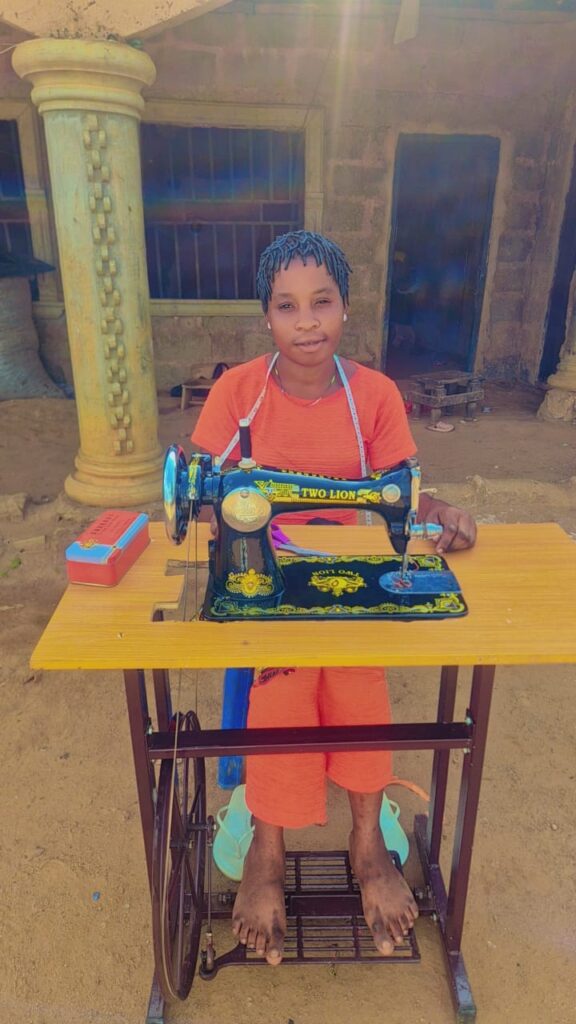
Today, Akwari is the only seamstress in her village. Clients travel from neighbouring communities to bring her their work. She earns between twenty and thirty thousand naira every month. She has savings. She has dignity. And she is now training other young women in her community, multiplying the return on a single well-executed intervention across an entire social geography.
That last detail matters more than any single income figure. Chinwe Okonkwo completed the fashion design track through a similar skills programme and opened her own tailoring business. She now employs two other young women. Amina Yusuf received educational support and is currently studying computer science at university. Mallam Ibrahim had his home repaired and received a small business grant through the Community Support Programme. He runs a shop that sustains his household.
These outcomes are not exceptional. They are what happens consistently when an intervention is designed to close all three gaps simultaneously: skill, tool, and market. The compounding logic of one good intervention is not sentiment. It is documented economic reality.
How LiftOne’s Skill Lift Programme Is Closing the Gap
LiftOne Humanitarian Foundation was founded on a conviction that has not shifted: talent should never suffocate in poverty.
Through the Skill Lift Programme, we provide unemployed youth and adults across Nigeria with market-relevant vocational training in fashion and tailoring, technical trades, and culinary arts. Every graduate receives startup equipment and materials, because we understand, categorically, that a skill without a tool produces frustration and not income. Read more about Skill Lift
Through the Education Lift Programme, we keep children in school who would otherwise be forced out, providing full and partial scholarships covering fees, uniforms, and learning materials, supplementary tutoring, and digital literacy training that prepares young Nigerians for a modern economy. Support a child’s education
Through the Community Support Programme, we reach the elderly, widows, and persons with disabilities with housing assistance, monthly food packages, and free healthcare access in partnership with local health providers, because self-sufficiency begins with basic security.
We are guided by four values that shape every programme decision we make: Dignity Over Charity. Transparency Over Optics. Quality Over Quantity. Honesty Over Empty Promises.
The 80 million young Nigerians sitting outside every training pipeline are not invisible because they are unimportant. They are invisible because the institutions meant to serve them have consistently underestimated what becomes possible when genuine support reaches them at the right moment.
We do not underestimate them.
If you share that conviction, we would like you to be part of what we are building.
Donate at www.liftonefoundation.org via Paystack, secure and direct. Partner with us at partnerships@liftonefoundation.org
Lifting Lives. Building Futures.